
Where Has All the Music Gone?
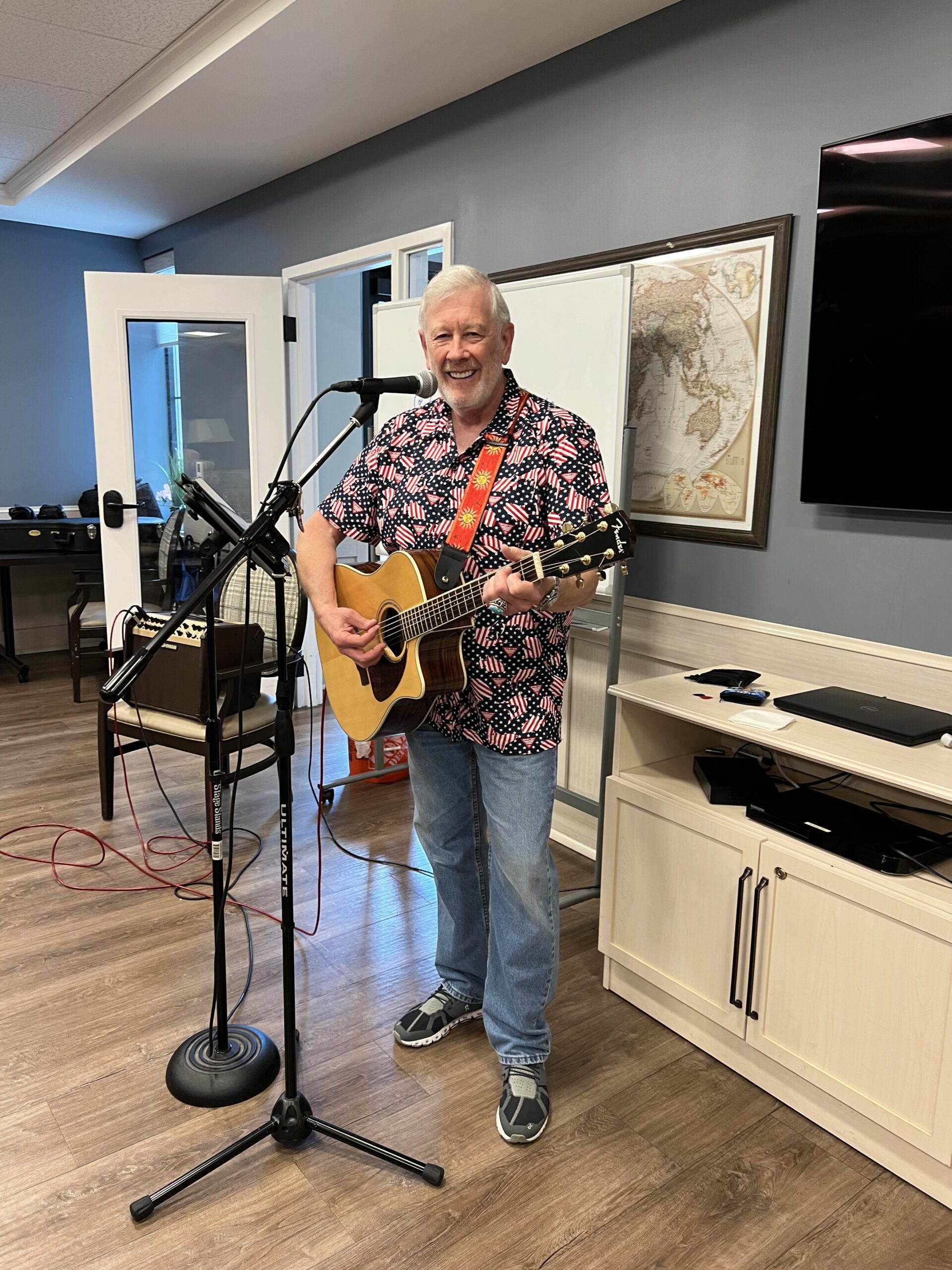
Lynn Woolley playing the oldies at Belmont Village, Lakeway, Texas on July 6, 2023.
Sometime around mid to late January 1964 I turned on the radio and heard “I Want to Hold Your Hand” for the first time. At that point in time, my life changed. The song seemed odd to me, unusual, and yet magically compelling. It drew me in and made me realize there could be something beyond the current pap that was being marketed to teenagers such as myself.
To be accurate, the Beatles were not the first to break the mold.
Two artists come to mind that date back to the fifties: Chuck Berry and Buddy Holly. Both of them, and especially Holly, were setting a new standard in the late fifties as the first of the new breed of singer-songwriters. Even before them, Bill Haley and His Comets were helping invent rock and roll, but today, their music sounds a bit dated.
The difference with Berry and Holly was that they mostly wrote their own songs and seemed to ignore what had come before. Berry wrote several classic rock songs that will live forever including “Johnny B. Goode,” “Memphis,” and “Sweet Little Sixteen,” and he could play the guitar riffs while doing the iconic Chuck Berry “duck walk.”
Video: The Beatles perform “I Want to Hold Your Hand” on the Ed Sullivan Show on CBS February 9th, 1964.
It was Holly and his band the Crickets that actually set the stage for what was to come less than a decade later. The band consisted of a front man (Holly) and four total pieces including lead guitar, rhythm guitar, bass, and drums. Note that the Beatles used the exact same configuration and even paid tribute to Holly by using a group name reminiscent of “Crickets.”
RELATED: I’ll Never Get out of This World Alive
I’ve thought over the years about what individual artist actually spearheaded the British Invasion and I definitely think it’s Holly. If you listen to Bill Haley’s records, they seem tethered to the early fifties sound – lots of saxophone and such – while Berry’s songs often sounded formulaic. There not a lot of difference in “Johnny B. Goode” and “Roll Over Beethoven,” for example.
Buddy Holly broke that mold.
Video: Before the Beatles, Buddy Holly performed “Peggy Sue” on the Ed Sullivan Show on December 1, 1957.
You could revel in the amazing energy and drumbeat of “Peggy Sue,” and flip the record over and hear a beautiful love ballad called “Everyday,” both written by Holly with a credit to producer Norman Petty who demanded some of the publication rights. Every little thing Holly did was adapted by the Beatles from the group’s name to the eventual decision to record only original material, and to the glorious melodies and harmonies that resulted.
January 18, 1964 was a day that changed the world of music, and my life.
On that day, “I Want to Hold Your Hand” entered the Billboard Hot 100 at #45. From then forward, crooners like Andy Williams and pop creations like Fabian, and even Elvis Presley, would never be the same. Of course, the record became #1 and remained there for seven weeks, only to be replaced by “She Loves You,” also by the Beatles. From that point forward, the Beatles were constant innovators.
A fun memory for me is that the two big thrills of my life in my mid-teens were the anticipation of a movie date with a pretty girlfriend and waiting to hear the next release from the Beatles. That’s how great the music seemed to me, and it completely erased any desire to hear such standard radio fare as “Take Good Care of My Baby” by Bobby Vee. That’s a good song written by Carole King and Gerry Goffin, but that’s the point. Vee’s producer, Snuff Garrett found the song. He chose it for Bobby Vee, and worked with the songwriters to customize it, and then he produced it. Bobby Vee was just a pretty face that could sing.
Video: Bobby Vee with “Take Good Care of My Baby” circa 1961. Snuff Garret suggested the introductory verse.
King and Goffin wrote some of the best pops songs ever including “Chains” for the Cookies, which was covered by the Beatles in the early years. But, working with George Martin, the Beatles set a completely new standard. They wrote and performed their own music, experimented in the studio, and grew musically though the years. Early pop singers were required to keep pumping out the same old stuff while the Beatles went from “Love Me Do” to “Strawberry Fields Forever.”
Buddy Holly and the Beatles brought the second big musical reformation of my life.
When I was a toddler, radio stations still shied away from rock and roll, preferring the Frank Sinatra, and big band sound. It wasn’t until advertising agencies decided that buying patterns were established early in life that radio stations began targeting younger audiences.
Prior to that, the prevailing thought was that teenagers had no money, so advertisers went for a more mature listening base: Sinatra. Dean Martin. Even Elvis Presley. But the older demographic morphed into a “key demo” of 25-54. Advertisers like Coca-Cola wanted teens. Radio changed to keep the dollars flowing.
RELATED: Stitches in Time: A Trilogy – Now Available from Planet Logic Press
The advent of the Beatles made AM radio as powerful as it could be. And there were no “B” sides to a Beatles 45 R.P.M. single. The flip side of “I Want to Hold Your Hand” was “I Saw Her Standing There.” That song is also a standard. It opens with Paul McCartney yelling a countdown and then the iconic line: Well, she was just seventeen you know what I mean…
In those days there were no crappy B sides for the Beatles and no throwaway songs. Radio stations played every Beatles song they could find. Music had changed. Then came The Dave Clark Five, the Rolling Stones, the Who, Herman’s Hermits, the Animals and more from England.
Meanwhile, in America, the Beach Boys knew they had to compete and they did. Brian Wilson’s genius kept the Beach Boys relevant and the Four Seasons were able to stay on the charts as well.
Video: Pure genius. The Beach Boys at their finest with “Don’t Worry Baby.”
Then came Paul Revere and the Raiders, Creedence Clearwater Revival, and more. But they were different. The bands were self-contained and mostly wrote their own music. Andy Williams singing “Born Free” began to seem quaint.
We are now in the third music reformation.
Country music, especially, has made a 180. I call it “redneck rap” because, like rap, there’s not much in the way of melodies, or hooks, as we used to call them in the business. A hook was the part of a song that got stuck in your head and made you want to buy the record.
On the pop side, there’s Taylor Swift who undeniably has created a sensation. But on the few times I’ve tuned into a contemporary hits station, I don’t last long. The music seems uniformly bland to me, missing the great harmonies of the Beatles, the Everly Brothers, the Beach Boys, and Simon and Garfunkel.
Noel Paul Stookey of Peter, Paul and Mary once said that harmony is happiness in your head. I could not agree more. The Beatles could rock, sure, but they could do beautiful harmonies on songs like “Girl,” and “If I Fell,” and so many more. Si and Gar were almost the rebirth of Don and Phil Everly, but with the sensibilities of the sixties. Listen to the Beach Boys’ a capella version of “Auld Lang Syne” sometime and it will blow you away.
I think it’s a matter of changing times and changing tastes.
Today’s teenagers may enjoy some Beatles songs, but mostly they like what’s “trending” now. FM contemporary stations laugh at you if you suggest they insert a Beatles song into the on-air rotation. Today’s oldies are far more recent than the Beatles, and the dwindling radio audience might punch to another station if a Beatles song comes on.
Satellite radio to the rescue as SiriusXM has an entire channel dedicated to the Beatles and sometimes the Beach Boys get a full channel for a while. I have a button on “50s Gold,” “60s Gold,” “Willie’s Roadhouse,” “Elvis Radio,” and “The Beatles Channel.” I take solace in the thought that a newer artist, Stephen Sanchez, recently scored a hit with “Until I Found You” which has been described as “retro.” I think “retro” means “good.”
Video: “Until I Found You” by Stephen Sanchez from the debut album Angel Face.
“Until I Found You” is an excellent song and gives me hope.
Where has all the music gone?
Gone to SiriusXM, You Tube, and languishing in our old collections of albums and 45s. I still have a turntable. I still use it. The music still exists at “The Mansion,” and always will so long as I’m alive and sentient. I still play it on the retirement community circuit to people who have no idea who Taylor Swift is.
Keep your chin up. Sanchez’s song found an audience with young people, and the older musical acts can still fill up Austin’s Moody Center, assuming the musicians are still capable of performing. The music of Buddy Holly and the Beatles, like that of Sinatra and Elvis, will never die.
The late Rush Limbaugh called it “our music” – the soundtrack of our lives when we were kids in the sixties. We were so fortunate to have that music — the best of all time – brought to us by the wonderful sound of AM radio and disc jockeys that were invariably the most famous people in their towns.
Times change and tastes change, yes, but life is cyclical. When today’s music gets stale, audiences may signal that it’s time for another shift. Good music with melodies and harmonies may come back in vogue. It can’t happen soon enough for me.
 Lynn Woolley is a Texas-based author, broadcaster, and songwriter. Follow his podcast at https://www.PlanetLogic.us. Check out his author’s page at https://www.Amazon.com/author/lynnwoolley.
Order books direct from Lynn at https://PlanetLogicPress.Square.Site.
Email Lynn at lwoolley9189@gmail.com.
You didn’t buy 10 copies for Christmas did you? For shame!